S.01
Grounds & Lawn
Striped mowing, crisp edging, pruning cycles, mulch and seasonal color, irrigation checks. The weekly rhythm.
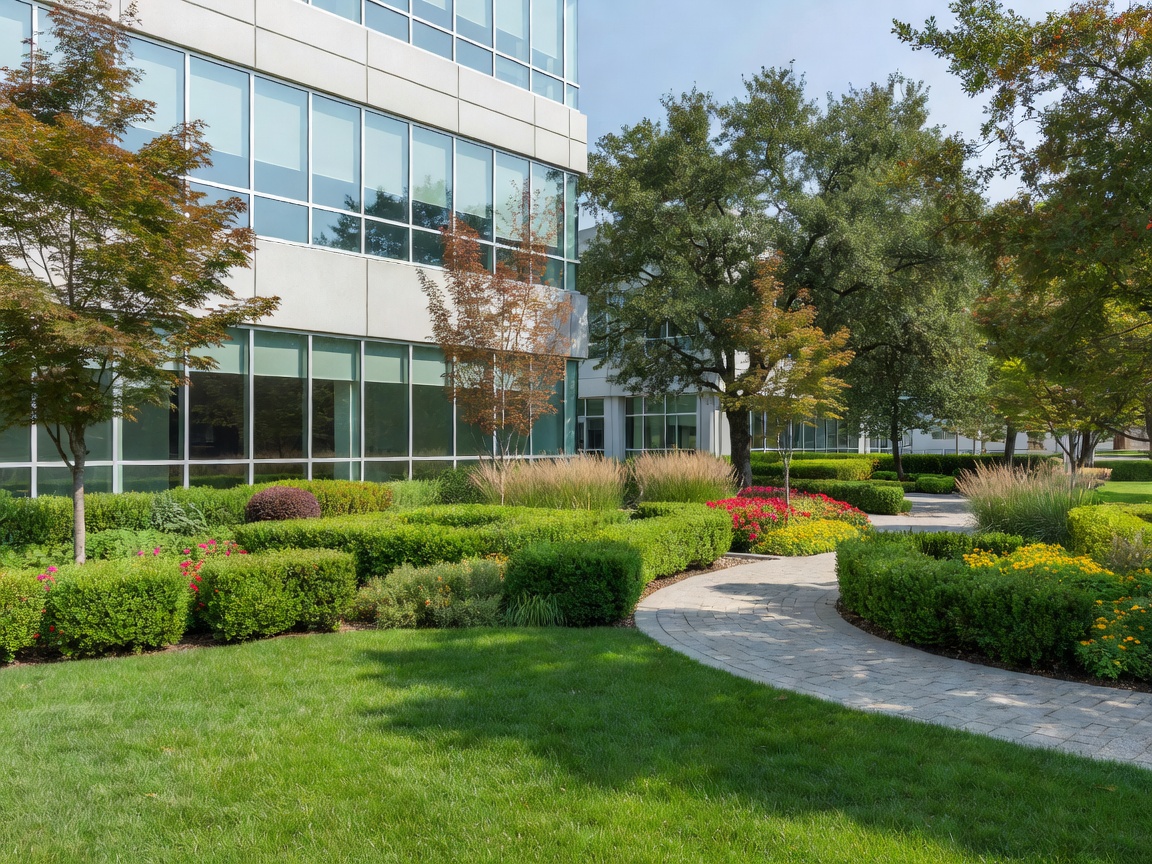
Nobody ever signed a lease because of mulch. But plenty of people have decided — in the four seconds between parking and the front door — what kind of operation they're walking into.
Spring on the Front Range arrives like an argument: eighty degrees on Tuesday, snow on Thursday, hail sometime in between just to keep everyone honest. Commercial ground takes the worst of it. Turf comes out of winter patchy and compacted. Beds are full of last October. Irrigation heads spent the winter getting acquainted with frost heave.
Our April is a reset, not a reaction. One heavy pass: debris and broken limbs out, beds re-edged with a clean line, irrigation woken zone by zone and pressure-tested before a single head is trusted. Turf gets its first cut at a sane height — scalping in April is how you buy yourself a brown June.
Then the rhythm starts. Same crew, same day. By the time your tenants stop noticing the grounds at all, we're doing it right — good maintenance is invisible. What's visible is the alternative, and every property manager in Denver has a story about the year they tried to save money on it.
The phone rings at 4 AM in January for one of two reasons: the plow is already moving, or it isn't. There is no third option that ends well.
Denver averages a snow season that runs October to April, and the storms that matter arrive overnight. A commercial lot at 7 AM needs to be a solved problem — drives plowed, walks shoveled, entries treated — before the first employee's tires touch it. Anything less is a liability file waiting for a name.
So winter is planned in October, when the pavement is still visible. Every route pre-mapped: where the piles go, which entries get sequenced first for early tenants, what the trigger depth is — 1 inch, 2 inches, your call, in writing. Equipment staged before the first forecast, not after.
When the storm comes, crews run overnight and every visit is time-stamped and logged. Plow time, shovel time, de-ice time, salt or magnesium chloride and how much. Your insurer has never asked for that log. The day they do, you'll be glad it exists.
Nobody photographs a parking lot for the brochure. Everybody judges one — cracked, faded, weeds in the seams — while walking to your door.
Asphalt fails from the top down and the water gets in through the cracks. Denver's freeze-thaw cycle is particularly good at turning a small crack into a pothole into a base failure into a five-figure replacement. The economics are boring and unambiguous: seal the cracks early, sealcoat on a cycle, patch before it spreads.
We run pavement on a multi-year plan, not a panic cycle. Crack sealing in spring before the water season. Sealcoating scheduled at night or on weekends so the lot stays usable. Overlays where the surface is tired but the base is sound — replacement only when the math says so, and we'll show you the math.
Every spring you get a condition report with photos: what's holding, what's moving, what can wait a year. Pavement managed this way stops being a surprise line item and becomes what it should be — a maintenance number you can budget.
Debris out, irrigation startup and pressure test, bed re-edge and mulch, first mow cycle. The property goes from "survived winter" to "open for business."
Weekly mow and edge, irrigation tuned against heat, hedges on rotation, storm response on call. The season the property is judged most — and noticed least.
Leaf routes until the trees quit, turf cut down for winter, irrigation winterized before the hard freeze, snow routes pre-mapped and staked.
Trigger-based plowing and shoveling overnight, de-icing ahead of morning traffic, time-stamped logs after every event. The paper trail your insurer likes.
The cheapest bid usually means a different crew every visit, nobody in November, and a phone number that goes to voicemail during a blizzard. We built the company to be the opposite of that story.
Named crews on fixed routes. The same people learn your property's quirks — the corner that ponds, the bed the last company scalped, the tenant who parks on the valve boxes. Visit forty looks like visit one because it's the same hands.
We take on a set number of properties per route and stop. It's the only honest way to promise winter response times: every property on a route gets the same priority, because the route was built for exactly that many.
Commercial only — offices, retail, HOAs, industrial, hospitality. No residential drive-bys splitting the crews' attention. One point of contact who answers, photo-documented issues flagged before they become someone else's invoice, and a single monthly number you can budget around.
Striped mowing, crisp edging, pruning cycles, mulch and seasonal color, irrigation checks. The weekly rhythm.
Trigger-based plowing, walks and entries, calibrated de-icing, time-stamped logs. Planned in October, executed at 2 AM.
Crack sealing, patching, sealcoat cycles, overlays. Night and weekend scheduling; spring condition reports with photos.
Bed and entry redesign, low-water conversions, drainage fixes. For properties whose bones are tired. Priced as a project.
On sample pricing, honestly: a seasonal grounds plan for a property up to ~2 acres typically starts around $1,450/mo (sample); a year-round contract with winter included around $2,300/mo (sample); asphalt care around $0.28/sq ft (sample). Every property prices differently — the walkthrough is free and the written scope is fixed before work begins.
On starting: walkthroughs usually happen within a week of your call at (555) 010-2030, Mon–Fri 7am–5pm. Written scope within days. If our routes are full, we'll tell you straight — and when the next slot opens.
The walkthrough takes about forty minutes. We bring a measuring wheel, a soil probe, and opinions. You bring whatever's been bothering you about the grounds — the dead corner, the lot that floods, the winter that scared you. We leave you with a written scope and a fixed number.
No 40-page proposal deck. No "as needed" hand-waving. Just a crew that shows up on the same day, does the same standard, and answers the phone in January at 2 AM — because they're already awake and already moving.